
(Theodoros Vryzakis (oil painting, 1852, Benaki Museum, Athens) illustrates Bishop Germanos of old Patras blessing the Greek banner at Agia Lavra on the outset of the national revolt against the Turks on 25 March 1821.)
The Greek War of Independence, also known as the Greek Revolution was a successful war of independence waged by the Greek revolutionaries between 1821 and 1830, with later assistance from several European powers, against the Ottoman Empire. In 1814, a secret organization called the Filiki Eteria (Friendly Society) was founded with the aim of liberating Greece. The Filiki Eteria planned to launch revolts in Peloponnese. The Peloponnesian revolt was quickly followed by revolts in Crete, Macedonia and Central Greece. The Ottoman Sultan negotiated with Mehmet Ali of Egypt, who agreed to send his son Ibrahim Pasha to Greece with an army to suppress the revolt in return for territorial gain. Ibrahim landed in the Peloponnese in February 1825 and had immediate success: by the end of 1825, most of the Peloponnese was under Egyptian control, and the city of Messolonghi—put under siege by the Turks since April 1825—fell in April 1826. Although Ibrahim was defeated in Mani, he had succeeded in suppressing most of the revolt in the Peloponnese and Athens had been retaken. Following years of negotiation, three Great Powers, Russia, the United Kingdom and France, decided to intervene in the conflict and each nation sent a navy to Greece. Following news that combined Ottoman–Egyptian fleets were going to attack the Greek island of Hydra, the allied fleet intercepted the Ottoman–Egyptian fleet at Navarino. Following a week long standoff, a battle began which resulted in the destruction of the Ottoman–Egyptian fleet. With the help of a French expeditionary force, the Greeks drove the Turks out of the Peloponnese and proceeded to the captured part of Central Greece by 1828. The three powers finally agreed to create an independent Greek state under their joint protection, and concluded the Protocols of 3 February 1830, with Nafplion as its capital and Ioannis Kapodistrias as the first head of state (Governor) of independent Greece.
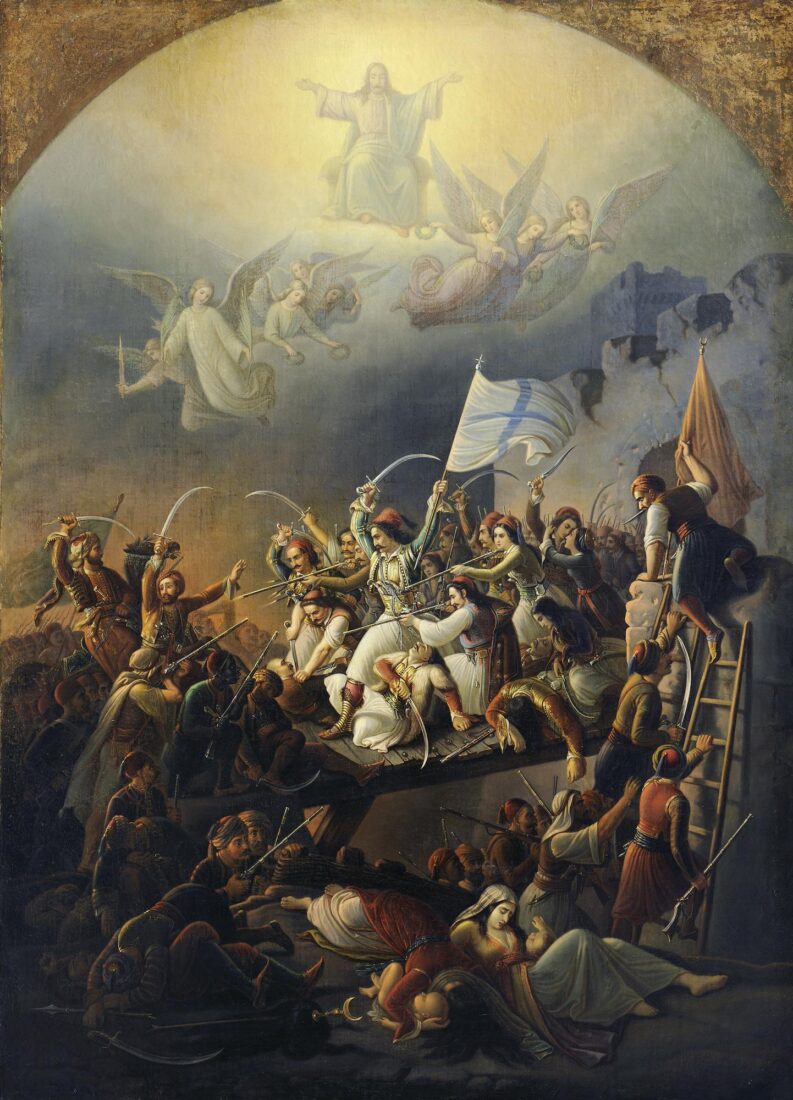 |
| The sortie of Messolonghi by Theodoros Vryzakis (1855). |
Kolokotronis' greatest success was the defeat of the Ottoman army under Mahmud Dramali Pasha at Dervenakia in 1822. In 1825, he was appointed commander-in-chief of the Greek forces in the Peloponnese. Today Kolokotronis also known by his nickname " O Geros tou Morea" is among the most revered of the protagonists of the War of Independence.
The most influential of the Greek writers and intellectuals was Rigas Feraios. His nationalist poem, the Thourios (war-song), was translated into a number of Western European and later Balkan languages and served as a rallying cry for Greeks against Ottoman rule।


No comments:
Post a Comment
Note: Only a member of this blog may post a comment.